


Performance
Lean portfolio management: successfully implementing strategy
Dynamic markets, economic uncertainties and new technologies present companies with major challenges. It is important to act quickly, develop innovative products and achieve maximum benefit with existing resources. Lean portfolio management helps companies in the VUCA world to react dynamically to changes by combining strategy, financing and implementation. In this way, companies create transparency about their initiatives and ensure that the right things are implemented.
What is lean portfolio management?
Lean Portfolio Management (LPM) is an approach that combines corporate strategy with operational implementation - in a lean, responsive way. The aim is to continuously align investments with benefits and impact. Instead of rigid annual planning, Lean Portfolio Management relies on rolling planning cycles, decentralized decisions and close coordination between management and the teams that implement the strategy on a daily basis.
The focus is on three questions:
- Are we working on the right issues?
- Are we implementing these efficiently?
- Do we learn quickly enough from results?
Lean portfolio management creates transparency, clear decision-making mechanisms and continuous portfolio management.
The term comes from the Scaled Agile Framework® (SAFe)but is rooted in the principles of Lean Thinking - a management approach that was originally developed in the Toyota production system in the 1950s. Lean stands for the consistent focus of all activities on value creation: waste is avoided, decisions are made where the knowledge is, and improvement is a continuous process.
In terms of portfolio management, this means that investment decisions are no longer based on the budget year, but on strategic value streams - and are regularly adjusted on the basis of the latest findings.
Give us a call.
"We help you to introduce lean portfolio management and get everyone involved - the management and the people who implement the strategy."
Why Lean Portfolio Management is crucial for companies
Classic portfolio management, which is typically close to the management, often only sets very abstract goals. In portfolio processes that are separate from the implementers, important details and changes in the market often remain unconsidered. This later proves to be an obstacle in day-to-day work. It is not so easy to change this in traditional portfolio systems: there is no provision for rolling adjustment to the current factual situation.
Further challenges are:
- Too many parallel initiatives without clear prioritization
- Strategies that are not implemented
- Budgets that are rigidly allocated and have little impact
- Lack of transparency about progress and results
The result: high capacity utilization but low impact.
This is precisely where lean portfolio management comes in and ensures that resources are used where they make the greatest contribution - with, by and with the people who implement the strategy.
Download case studies (only available in German):
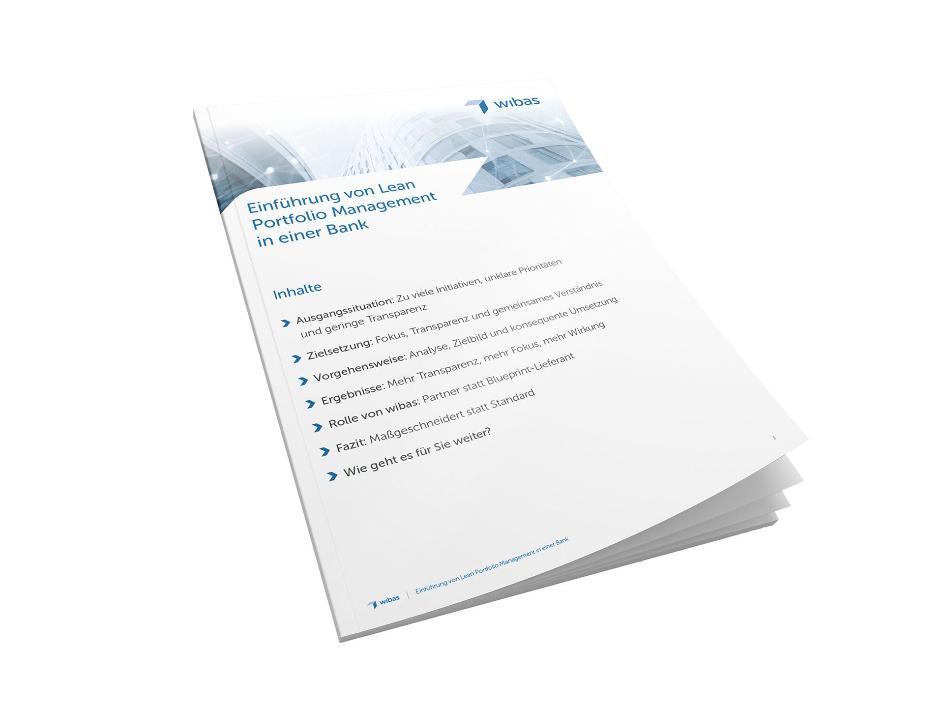
Introduction of lean portfolio management in a bank
Introduction of lean portfolio management in the IT department of a corporate group
How does lean portfolio management work?
Lean portfolio management is divided into three closely linked areas:
Strategy & Investment financing
Instead of individual projects, strategic value streams are identified and financed. The portfolio budget is allocated to these value streams - flexibly and adaptably, not fixed once for an entire year. This allows the company to react to changing market conditions without having to initiate costly rescheduling processes.
Agile Portfolio Operations
The operational level is actively involved in the portfolio process. Regular coordination cycles (e.g. PI Planning in the SAFe® context) ensure that strategy and implementation remain synchronized. Prioritization, dependencies and capacities are made transparent - across teams and in a comprehensible manner.
Lean governance
Instead of bureaucratic control, lean portfolio management relies on lean control mechanisms: clear metrics, regular reviews and a culture of continuous improvement. Decisions are made where the information is - not exclusively in top management.
Lean portfolio management is based on central lean principles that are consistently transferred to the portfolio level:
1. value orientation
All investments and initiatives are evaluated according to the benefits they create for customers and the company. Activities without a clear value contribution are scrutinized and reduced.
2. value stream thinking
Instead of thinking in terms of projects, we think in terms of end-to-end value streams - from idea to delivery. This creates clarity about where bottlenecks arise in the system and where investments have the greatest leverage.
3. flow instead of batch
Work flows continuously through the system instead of being launched in large annual planning packages. Shorter planning cycles enable faster feedback and early course correction.
4. pull principle
Teams pull work based on their actual capacity instead of being overloaded with tasks. This leads to more realistic planning and better quality.
5. continuous improvement (Kaizen)
Lean portfolio management is not a one-off implementation project, but an ongoing improvement process. Retrospectives and regular reviews at portfolio level are an integral part of this.
The vision: responsive portfolio management
Companies that implement Lean Portfolio Management typically enjoy the following improvements:
- Faster decision-making cycles: instead of once a year, investment decisions are made quarterly or more frequently thanks to rolling planning - based on current data instead of outdated planning assumptions.
- Better allocation of resources: Budget and capacities flow to where they have the greatest strategic leverage - not to where the politically strongest voice is.
- Higher implementation rate: Because operational teams are involved in planning, more realistic targets are created in shorter planning cycles - and the gap between strategy and day-to-day business shrinks noticeably.
- More transparency: Portfolio Kanban, value stream dashboards and OKRs make visible what the company is working on and why.
- Responsiveness in uncertain markets: If market conditions change, the portfolio can be adjusted - without having to completely re-plan.
How we support you with lean portfolio management
We support companies in shaping their strategic management effectively - without creating additional complexity.
This is not about introducing a framework, but about finding effective solutions for your specific situation:
- Clarification of strategic goals and priorities
- Creation of transparent portfolio structures
- Establishment of clear decision-making mechanisms
- Improving the flow of work across departments
Our focus is on sustainably improving your organization's ability to deliver.
Questions about Lean Portfolio Management
Traditional portfolio management typically plans a year in advance, is highly centralized and not very flexible. Lean portfolio management, on the other hand, works with rolling planning cycles, actively involves operational teams and can react quickly to changes. The key difference: lean portfolio management combines strategy and implementation on an ongoing basis instead of once a year.
Lean portfolio management stems from the Scaled Agile Framework (SAFe) and connects Lean principles (originally from the Toyota production system) with agile planning approaches. It is an answer to the question of how companies can make their portfolio management more responsive in a VUCA world.
Lean portfolio management is particularly relevant for medium-sized and large companies that manage several parallel initiatives, products or value streams - and find that traditional annual planning is too slow to react to market changes.
This depends on the initial situation. The first noticeable improvements can often be seen after just 3-6 months. Full integration into the company typically takes 12-18 months - accompanied by coaching, training and regular retrospectives at portfolio level.
Give us a call.
"We help you to introduce lean portfolio management and get everyone involved.
CASE STUDY DOWNLOAD
"Introduction of lean portfolio management in a bank"
CASE STUDY DOWNLOAD
"Introduction of lean portfolio management in the IT department of a corporate group"
Agile organization
Becoming an agile organization is a goal for many companies. Linked to this is the desire to become more responsive and to be able to adapt more quickly to changing markets.
SAFe® Lean Portfolio Management (LPM)
In this SAFe Lean Portfolio Management training you will learn how to create a strategic alignment of the organization with Lean Portfolio Management.
Strategy Development with Agility
Use agile techniques to accelerate your strategy development and promote cross-functional thinking.
Your expert for Lean Portfolio management:
Jörg Battenfeld
wibas GmbH
Jörg Battenfeld
Otto Hesse St. 19B
64293 Darmstadt
+49 6151 503349-0


