


Performance
Leadership development for modern organizations
In order to increase delivery capability and customer focus in the organization, managers must be able to create the framework for this. Our leadership development concepts and programs offer a range of elements that can create the conditions for this. We put the elements together into a tailor-made programme according to the needs of your organization.
Leadership in modern organizations
Today, leadership means more than just disciplinary responsibility. In modern organizations, many people take on leadership roles - even without the title of "boss": team and project leaders, Product Owner, Scrum Master, Agile coaches or specialist managers. It is not the role that is decisive, but the contribution: providing direction, shaping the framework and enabling collaboration in such a way that value is created - for customers and for the organization. Modern managers need a mindset to recognize the most important values and principles that lead to value creation. Performance to be able to support them.
When leadership succeeds, work becomes more focused, decisions are made faster, responsibility becomes clearer - and teams can deliver reliably without constantly running at the limit.
What does management development at wibas involve?
For us, leadership development is an interplay of competence building, practical application and organizational anchoring. We develop leadership along three levels - because effectiveness is rarely just a "personal issue":
1) Self-management and attitude
Set priorities, make decisions, create clarity, remain capable of acting in times of tension - and understand your own impact on the system.
2) Cooperation and communication
Effective communication, feedback and conflict resolution skills, moderation of decision-making and planning formats, stakeholder alignment - especially where many interfaces come together.
3) Systemic leadership: framework, structures and governance
The ability to deliver is also created by structures: responsibilities, decision-making channels, work flow, target and control systems. Leadership development therefore also includes the question: What needs to be changed in the organization's "operating system" to make good work possible?
Transfer to everyday life
To ensure that development does not end in the seminar room, we work consistently with practical cases, transfer tasks and (where appropriate) sparring between modules.
Contact us or make an appointment directly with one of us. We are Timo Foegen, Yvonne Fischer, Tina Eisoldt, Daniel Votta and Lutz Koch. We look forward to your questions.
Our management development formats: Training, coaching and mentoring
Depending on the initial situation, we combine different, proven formats - often in one program:
- Training builds skills and shared understanding: Methods, tools and concrete options for action - interactive and adapted to your context. You will take away methods and techniques that you can apply immediately (e.g. prioritizing, moderating, giving feedback). You will also learn from other leadership situations and recognize patterns - things become identifiable and therefore changeable.
- Coaching increases effectiveness in specific situations (1:1 or in a team): decisions, conflicts, role clarification, leadership in difficult constellations. Through dialog with an experienced coach, managers can improve their communication and decision-making skills, gain clarity with regard to their goals and increase their personal resilience. Coaching promotes self-reflection, strengthens confidence in one's own abilities and helps to successfully master challenges.
- Mentoring provides orientation and experiential knowledge: Role development, typical patterns and stumbling blocks, pragmatic "this is how it has worked" perspectives. A mentor helps you to position yourself in your role and make patterns visible - e.g. how you deal with pressure, harmony, control or delegation. Mentoring often works for months and therefore not only supports a problem, but also the sustainable development of your leadership practice.
The result is a development that strengthens competence as well as application and maturity in everyday life.

Training: Leading & delivering organizations (FLOW)
This training program addresses the challenges of leadership in our increasingly complex world in five modules. It enables participants to lead in a targeted manner and to move their organization forward.
Masterclass Deliverable Organizations
The Masterclass Organizational Design for Deliverable and Customer-Centric Organizations addresses the patterns of modern organizations and enables participants to develop suitable structures for their organization.
Agile leadership - Agile Leader
In this interactive, workshop-style format, managers learn how leadership works in an agile context and use agile techniques for their own leadership work. They have a leadership-related target image and can accompany the change to an agile organization as a manager;

Managing with OKRs
One element of modern leadership is strategy implementation with objectives and key results. This implementation of the Hoshin Kanri principle enables management to implement its strategic goals in a very focused manner and is a way of increasing the organization's ability to deliver.
Deepdive high performing
organization
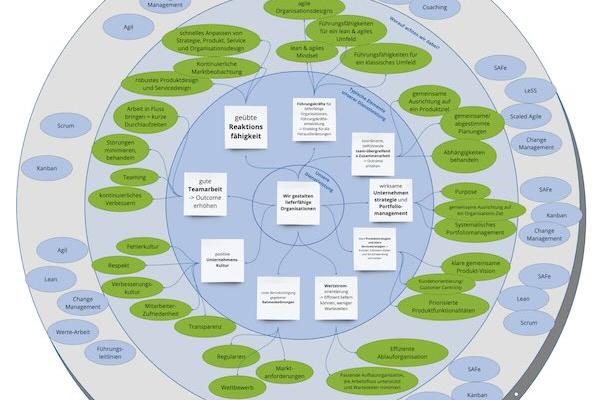
This training covers a range of topics that are essential for deliverable organizations. They also address other elements such as positive corporate culture, agile mindset, dealing with framework conditions and provide an overview of the prerequisites for an organization's ability to deliver.
Standard modules
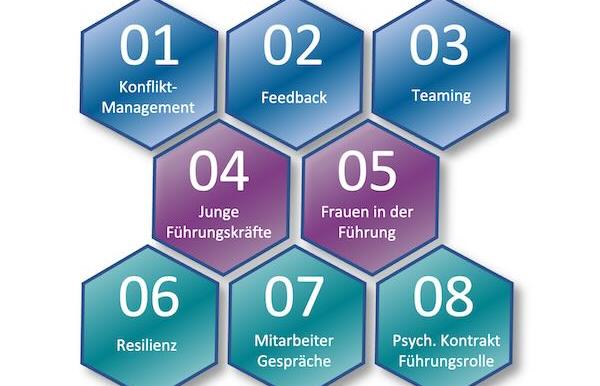
In addition to modern and agile leadership models, we offer training modules that also cover traditional leadership tools. These include topics such as personnel development meetings, feedback, incentivization, team development, conflict management, feedback and resilience.
Develop your own management style
As a manager, one of the ongoing tasks is to develop your own leadership style. To get started, it helps to have an overview of the leadership styles or leadership approaches currently being discussed. Below is an overview that provides a starting point:
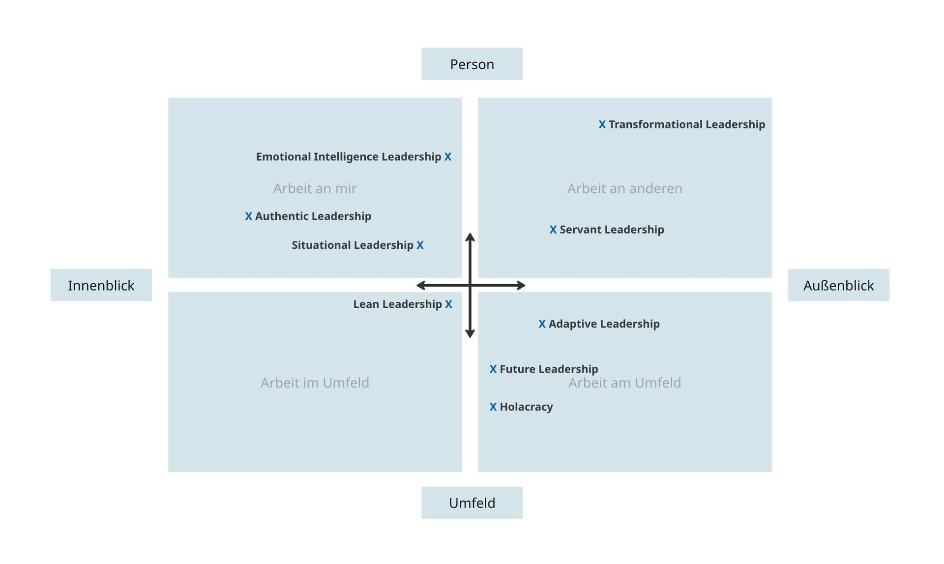
In this matrix, the various leadership approaches were categorized according to the extent to which they deal with different aspects. On the one hand, whether it is about looking at the people or changing the environment in which I act as a manager; on the other hand, whether it is an internal or external view. This consideration results in 4 fields into which various leadership approaches are categorized:
- Work on myself (person + inner view)
- Work on others (person + external view)
- Work in the environment (environment + internal view)
- Work on the environment (environment + external view)
Overview of different management approaches
Authentic Leadership
primarily Bill George, later Ilies et al.
Central idea: Leading authentically through self-awareness, value orientation, transparency and consistently ethical actions; inner attitude and outer behavior are consistent.
Typical focus: Examination of one's own values, strengths, limits and motives. This results in trusting relationships and credible leadership towards others.
Role of the employees: Active, self-reflective co-creators who are in trusting relationships, take on increasing responsibility and become "authentic followers" with a high level of identification and empowerment.
Structure vs. relationship: Clearly relationship- and value-oriented; structures are important, but more of a framework, while transparency, trust and psychological security are in the foreground.
Servant Leadership
by Robert K. Greenleaf, further developed by numerous authors
Central idea: Leading by serving others: the focus is on the needs of employees and their growth; power is shared, influence is created through support and empathy.
Typical focus: development and well-being of those being led. The leader reflects on themselves in order to act authentically and consistently in service to others
Role of the employees: Served followers to be nurtured and empowered to actively shape, take responsibility and become future leaders themselves through empowerment as well as serving together.
Structure vs. relationship: Strongly relationship and caring oriented; formal structures play a subordinate role to trust, service culture and collaborative teamwork.
Emotional Intelligence Leadership
by Daniel Goleman.
Central idea: Effective leadership through self-awareness, self-control, empathy and social skills.
Typical focus: Personal maturity of the manager, dealing with emotions, quality of relationships.
Role of the employees: Active dialog partners; their emotions and needs are consciously included.
Structure vs. relationship: Strongly relationship-oriented; structure tends to remain in the background.
Situational Leadership
by Paul Hersey, Ken Blanchard
Central idea: Leadership behavior is adapted to the level of maturity and development of the employees.
Typical focus: Flexible alternation between instructing, coaching, supporting, delegating.
Role of the employees: Depending on their level of maturity, employees are closely managed or given increasing responsibility.
Structure vs. relationship: Balance: Relationship design and clarity of tasks/structure are calibrated depending on the situation.
Lean leadership
Lean school of thought, including Womack, Liker, Rother
Central idea: Develop yourself, develop others, reduce waste and enable continuous improvement in the value stream, align organization.
Typical focus: process excellence, coaching on the "gemba", standardization with kaizen culture.
Role of employees: Problem solvers and co-creators in the improvement process; strong involvement in decisions on the process.
Structure vs. relationship: Strongly structure and process-oriented, supplemented by coaching relationships.
Transformational Leadership
- by James M. Burns, Bernard M. Bass
Central idea: "Transforming" people through vision, example and purpose to achieve above-average performance and personal development
Typical focus: inspiration, creation of meaning, cultural change.
Role of employees: Followership to become self-motivated co-creators.
Structure vs. relationship: Means: both relationship work (role model, inspiration) and change of culture and goals.
Adaptive Leadership
by Ronald Heifetz
Central idea: Difference between technical and adaptive problems; accompany organization in learning and change processes.
Typical focus: Dealing with uncertainty, experiments, collective learning, creating a "holding environment".
Role of employees: Active co-responsibility; all levels participate in dealing with adaptive challenges.
Structure vs. relationship: Focus on system and framework work; relationships important, but means for joint adaptation.
Future Leadership
by Mark Poppenborg, Lars Vollmer
Central idea: Toolbox for organizations in complex markets; focus on value creation, decision architecture and networks.
Typical focus: Design of decision premises, reduction of bureaucracy, promotion of self-organized value creation.
Role of employees: Employees as "value creators" who act independently within clear decision-making frameworks.
Structure vs. relationship: Clearly structure- and system-oriented, with an implicit focus on meaningful cooperation.
Holacracy
Main representative: Brian J. Robertson
Central idea: Authority is distributed to roles and self-organized "circles"; formal governance processes replace classic hierarchy.
Typical focus: Clear roles, iterative governance meetings, explicit rules for decisions.
Role of the employees: Role holders with a high degree of autonomy, acting within defined tension and decision-making processes.
Structure vs. relationship: Very strong focus on structure (roles, rules), relationships develop within this framework.
Insights into training: Leading deliverable organizations in times of change
Leadership approach: Authentic Leadership
How do different leadership styles influence an organization's ability to deliver? In the webinar (October 2025), Frank Eberhard went into the leadership approach ;Authentic Leadership according to Bill George .He explains in the following video:
- What Bill George, CEO of a medical technology manufacturer, understands by Authentic Leadership
- what a major American scandal has to do with it and
- what questions managers should ask themselves.
Leadership approach: Servant Leadership
As part of the first leadership webinar, Caroline Haußmann explains what makes a servant leader according to Robert K. Greenleaf and what the turbulent 1960s have to do with it.
Leadership approaches at a glance: From transformational leadership to holacracy
Caroline and Frank have created a 4-field matrix that shows the most discussed leadership approaches and positions them in relation to each other;
Contact us or make an appointment directly with one of us. We are Timo Foegen, Yvonne Fischer, Tina Eisoldt, Daniel Votta and Lutz Koch. We look forward to your questions.
FAQ
Leadership development encompasses self-management, effective communication and cooperation as well as the design of framework conditions in the system: roles, responsibilities, decision-making channels, work flow and target systems. The decisive factor is the transfer to everyday life - so that leadership becomes noticeably more effective and the organization can deliver reliably.
Training builds skills and a common language (methods, skills, tools). Coaching increases effectiveness in specific situations (1:1 or team) and provides support with decisions, conflicts and role clarification. Mentoring supplements experiential knowledge and orientation for role development and typical patterns in day-to-day management.
We offer a variety of development fields and formats to accompany, coach and train you on your leadership development journey. Just get in touch with us.














Better leadership and easier learning thanks to mentoring
A brief insight and the pros and cons of mentoring as a development opportunity for managers. In this article, a manager writes about her own everyday experiences with mentoring.

Toyota Lean Leadership: Leadership in Complexity
The Toyota Lean Leadership Model helps managers to survive in the VUCA world with clarity, learning ability and agility. Read this recent article by our colleagues Tina Eisoldt and Caroline Haußmann in Informatik Aktuell.
High Performing Organizations
The ability to deliver and customer focus are crucial characteristics for the success of any company. When teams and departments work together reliably and effectively, products and services are delivered on time. Read here which building blocks are relevant for this.
Leading high performing organizations through change
In this training course, you will develop your leadership skills for a modern organization in a complex world.
Masterclass high performing Organization
Do you use agile approaches or agile scaling in your company and are now looking for a suitable organizational design as a structure and framework? Then this Masterclass Deliverable Organizational Design is just right for you!
If working harder is not the solution ...
In the modern business world, where speed and efficiency are critical, leaders are often looking for ways to push their teams to higher [...]
What is an agile mindset?
An agile mindset is the cultural basis for an agile organization. On the way from a traditional to an agile organization, not only agile methods are important, but also a cultural change towards a more agile mindset.
Your contact person:
Frank Eberhard
wibas GmbH
Frank Eberhard
Otto-Hesse-Str. 19B
64293 Darmstadt
+49 6151 503349-0


